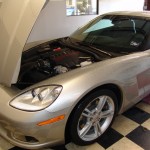

I spotted this rare silver Viper GTS ACR with blue stripes in a parking lot here in Georgia a few months ago. The American Club Racer, as it is designated, is a limited production Viper which is very rare in GTS form! Quite a stunning car!
Dodge Viper GTS ACR
This wonderful Viper GTS ACR was filmed at a car show a while back. Only 39 were made in it's Steel Gray color, and a total of only 218 were made in 2000.
Supercharged Dodge Viper SRT-10 Roadster revs
Here is an absolute beast that I filmed at Road Atlanta during the June 2010 NASA racing weekend. It was supercharged, to around 700hp I believe. He revs it a few times, teasing us with the V10's power. The owner runs the car on drag strips, but not on road courses.
Oh, and the red Viper GTS that prowls by during my filming is also supercharged. ;)
Roe Supercharged Viper GTS
Finally finished!!! This was the second startup. Roe Supercharger, Greg Good Heads, 8psi with David Weaver Pulley, Custom JE Pistons,Roe Methanol Injection, Custom Solid Roller Cam, T&D Roller Rockers, Custom Intake, Dual 255 Walbro fuel pumps. Shooting for over 750 to the wheels, we'll see how she does after some tuning and get her to the Dyno.
2000 Dodge Viper GTS FOR SALE high def HD
http://www.flemingsultimategarage.com 301.816.1000
8.0 liter 488cid aluminum V-10 @ 450hp, 6-speed close ratio trans, independent rear with limited slip, beautiful Viper red paint, extra cost Connolly leather interior, Alpine sound w/ CD and subwoofer, 18" factory polished alloys with Michelin pilots, air-conditioning, power windows + locks, keyless entry, Brembo disc brakes, only 13K original miles! Timeless style and sure to be a one day classic.
1998 Dodge Viper GTS with Charles (ASP) FULL HD
Check out the ASP's Blog: (http://autoshowcaseproject.blogspot.com/)
Auto-Showcase Project (ASP) presents Charles' 1998 Dodge Viper GTS.
The Dodge Viper GTS is the grand-dad of the new 2013 SRT Viper that was unveiled at the NY Auto Show of 2012.
There's a special place in my heart for MOPARS. This one has taken the cake. Charles owns his lovely 1998 Dodge Viper GTS in silver with blue racing stripes.
I thank Charles for showcasing his awesome 1998 Dodge Viper GTS.
I also thank my good friend Pablo for supplying the music to this video.
Don't forget to comment below, subscribe, and give me a thumbs up!
1992, 1993, 1994, 1995, 1996, 1997, 1998, 1999, 2000, 2001, "Dodge Viper", GTS, SRT, SRT10, SRT-10, ACR, drag, racing, burnout, Viper Club, US, muscle car, Top Gear UK, Jeremy Clarkson, Top Gear US, Tanner Foust, "2013 Dodge Viper", "Street and Racing Technology", Chrysler, Fiat, "2013 SRT Viper", MOPAR
**Quick Look**2000 Dodge Viper GTS--D&M Motorsports
A stunning 2000 Dodge Viper GTS with only 16K miles at D&M Motorsports. Hosted by Mr. Christopher Moran of AutoMedia.
So the saying goes: "If I have to explain, you wouldn't understand." Those who squint at the Dodge Viper, shrug, and say, "I don't get it," should just sit on their hands or buy something else.
The rest of us appreciate Dodge's outrageous musclecar for proving the company had the guts to produce what amounted to a concept vehicle for the street. A romping 8.0-liter OHV V-10 rendered in aluminum pushed 400 horsepower and 450 pound-feet of torque through a mandatory six-speed manual. Those rare early Vipers only 285 were built the first season (1992)--had nothing so civilized as air-conditioning, ABS, or traction control. Not even roll-up windows or external door latches. And no one seemed to care: The Viper was raw and elemental--and hugely popular for an impractical, $50,000 extravagance. Sales peaked in 1994 at 1926 cars, but just more than 14,000 were built through the 2002 model year.
Gradually, Dodge tamed the beast. In 1994, air-conditioning became a factory option (dealer-installed before), and in 1996, the side-exit Exhausts moved to the rear accompanied by 15 more horsepower. That year, the GTS coupe arrived with yet more power, 450 horses. In 1999, slightly hopped-up ACR versions became available. For 2000, Dodge fitted a regular Viper with a tamer camshaft that took some of the edge from the car's aggressive Exhaust note, while cast pistons replaced forged slugs. ABS came aboard in 2000.
Which Viper is best depends on your desires. Viper fanatics love the early cars for their back-to-basics approach. Also, it's said that the forged pistons handle the pressure of aftermarket supercharging better than the cast items. That said, the later cars are more liveable.
Viper enthusiasts say the car is reliable but not cheap to maintain. Look for blown head gaskets in the early models and evidence of racetrack experience--charred brake fluid and excessive tire wear. Check any extended warranty carefully; the factory's can be transferred once only. Many Vipers have been modified, but stick with stock unless you know what you're doing. Take a ride, and maybe then you'll understand.
So imagine our surprise to find that this car wasn't quicker and didn't handle better than stock. Part of the shortcoming can be traced to the less-grippy tarmac at the (not our usual) test venue. It did scorch a 3.9-second 0-60-mph time. But the quarter mile was a "mere" 12.4 at 117.6. Previous GTS Vipers had run 12.1 to 12.2 seconds and from 117.9 to 120.5 mph. Likewise, our 600-foot slalom test also yielded softer numbers than expected. Instead of somewhere around 68.5 to 72.4 mph, the ACRplus carved through at "just" 68.1 mph.
Fortunately, answers arrived the day after the test in a mail package listing the ACRplus' specs and from a short phone call to Mopar's experts. First, what we actually got despite the long list of engine parts was an only modest bump of 56 horses and 41 extra pound-feet of torque. A "stock" GTS Viper already makes an incredible 450 horsepower and about 490 pound-feet of torque. The second, but probably most important, factor in our just so-so quarter-mile times was the shorter 3.73:1 "performance" rear axle. Although it might have provided a nice advantage in a parking lot autocross, the shorter gear was causing the engine to hit the rev limiter at about 115 mph in third gear-just shy of a full quarter mile. (Note that the standard axle is a much taller 3.07.) The driver's choices were to run up against the limiter or attempt a quick upshift. Unfortunately, both strategies blunted quarter-mile times and speeds.
What about the slower pass through the slalom? The experts at Mopar disclosed that the car's adjustable shocks had been left on their softest settings. The result was a great riding Viper, but also a measurable loss in response. A few up clicks on the adjusters would've sharpened the car's response.
In the end, the real benefit provided by the Mopar's premium shocks was to ride comfort.
The shorter axle ratio does make the Viper's response even fiercer for timed handling events. At the dragstrip, however, the standard axle works best. The lesson: Do your homework carefully before you shop for parts or test a car. Otherwise, you may find performance improved, just not in the targeted area.